
Basic Theology by Charles C. Ryrie

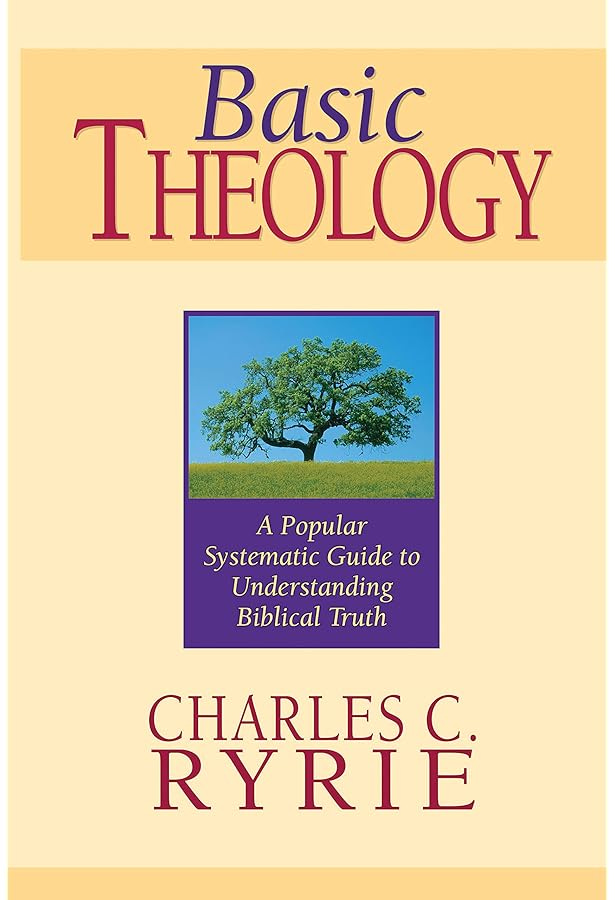
There are theology books that impress you with density, and there are theology books that actually help you think Christianly with clarity. Charles C. Ryrie’s Basic Theology sits firmly in the second category. It is a plain-spoken, strongly Bible-referencing, systematically organised guide to the major doctrines of the Christian faith, written so that ordinary church members can benefit, while still being structured enough to function as a handy reference work.
What the book is about
Ryrie sets out to provide a “basic” (not superficial) map of Christian doctrine: God, Scripture, angels, humanity, sin, Christ, salvation, the Holy Spirit, the Church, and last things. The chapters are short and arranged in an outline style, which makes the book unusually readable for systematic theology and unusually easy to consult later when a specific question arises.
A distinct strength is the book’s “tool-like” design: it is built to be used. Between the structured layout, glossary/definitions, indices, and frequent Scriptural cross-references, Ryrie is clearly aiming to form the reader’s theological instincts through repeated contact with the text of Scripture rather than through rhetorical flourish.
Why I found it so worthwhile
What I appreciate most is the book’s disciplined clarity. Ryrie does not write to impress; he writes to be understood. That may sound like faint praise until you’ve worked through enough theology to know how rare it is to find a large doctrinal survey that stays coherent, keeps moving, and still manages to say something definite.
The book also models a kind of theological “common sense”: definitions matter, categories matter, and conclusions should be tethered to biblical exegesis. Even when a reader disagrees with him at points (and thoughtful readers will), the work trains you to ask the right questions: What does the text say? How does this doctrine connect to other doctrines? What must be true if this passage is true?
In short: Basic Theology is not merely informative, it is formational. It helps the reader organise what Scripture teaches into a comprehensible whole.
Background and origins of the book
Basic Theology is closely associated with Ryrie’s long-standing role as a teacher of systematic theology (notably connected with Dallas Theological Seminary in his career).
Importantly, an academic review from Criswell Theological Review (hosted via Liberty University’s DigitalCommons) notes that the book was not simply a revision or expansion of Ryrie’s earlier 1972 doctrinal primer A Survey of Bible Doctrine; it is a fresh work with its own structure and development.
In terms of publication history, the work is widely catalogued as appearing in 1986 (Victor Books, Wheaton) and later in a widely distributed 1999 edition associated with Moody (often listed as Moody Press/Moody Publishers).
A fair word about critics of the book
No systematic theology sits above critique, and Ryrie’s work is no exception. The most common criticisms tend to cluster in three areas:
Dispensational and premillennial commitments
Ryrie is transparent about his theological framework, and the book gives notable emphasis to a dispensational approach, particularly in eschatology. For readers outside that tradition (for example, many Reformed or covenantal theologians), this can feel like a built-in bias rather than a neutral survey.“Basic” can mean “not deep enough” for some audiences
Even sympathetic academic reviewers have suggested that, while the book is admirably clear and compact, readers looking for a more expansive, heavily footnoted engagement with historical theology and contemporary debates may find it limited by design.Objections from other confessional traditions
In some circles, particularly among strongly Reformed readers, one encounters blunt negative reactions to Ryrie’s approach precisely because it represents a classic dispensational strand of evangelical theology. While that sort of critique is often more confessional than analytical, it is real and worth anticipating if you come from a different theological home.
My own view is that these criticisms are best handled by reading the book for what it is: a conservative, Bible-forward, systematic introduction written from an identifiable evangelical tradition. If you want a neutral “mere map” of theology with minimal theological commitments, you will not find it here. If you want a clear guide that aims to be faithful to Scripture and unembarrassed about its conclusions, you very much will.
Final Remarks
I would readily commend Basic Theology to church members who want to become more doctrinally grounded, to Bible teachers who need an accessible reference, and to students who want a systematic framework without drowning in technicalities. It is not the final word in theology, but it is an unusually serviceable and steady guide, and in an age of either shallow slogans or intimidating tomes, that combination is a genuine gift.