
Owain Glyndŵr
From Loyal Servant of the English Crown to Champion of Welsh Independence

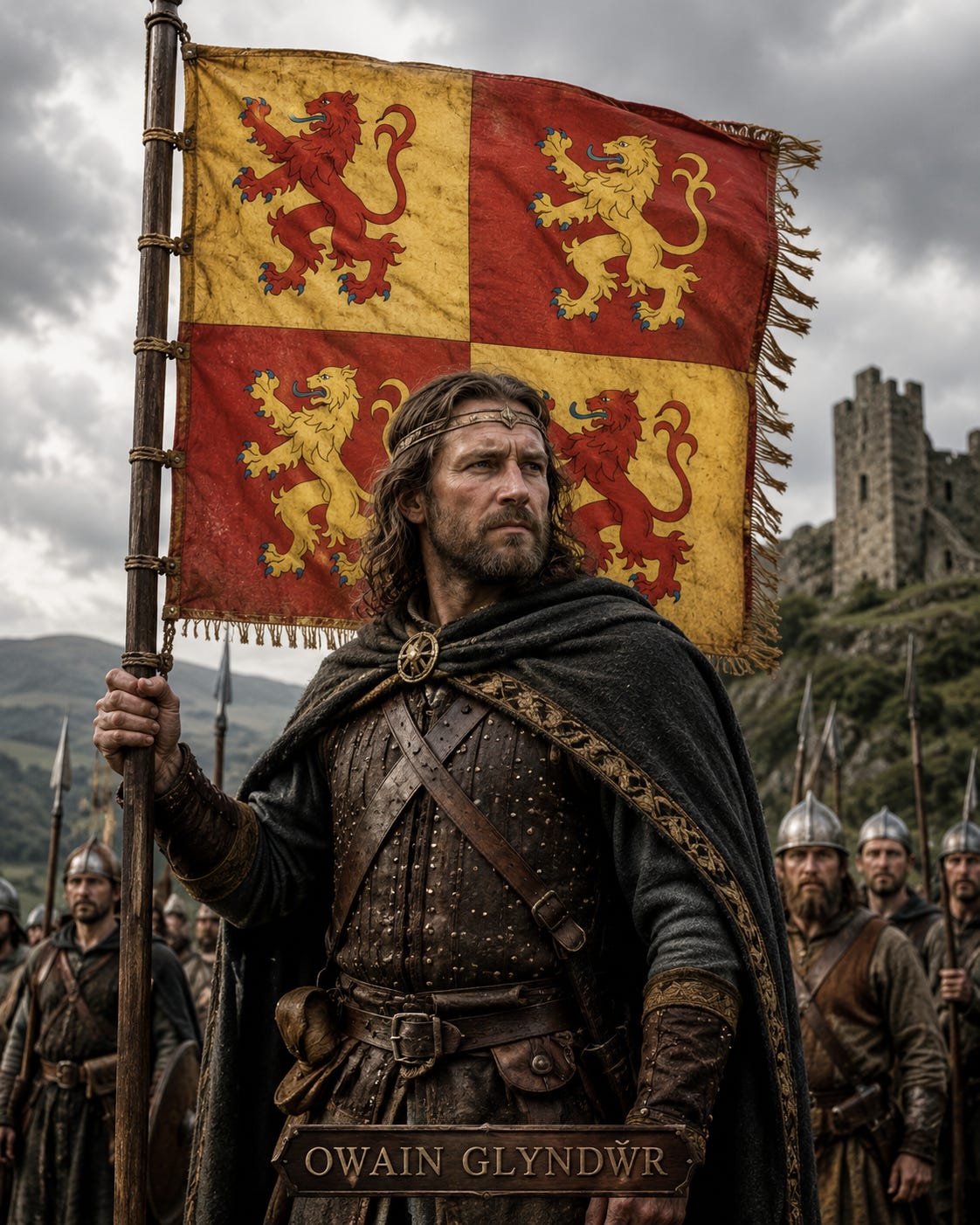
Few figures in Welsh history embody the complexities of medieval Britain more than Owain Glyndŵr. Remembered today as the last native Prince of Wales to lead a national uprising against English rule, Glyndŵr’s early life presents a remarkable paradox. Long before he became the symbol of Welsh resistance, he was a trusted servant of the English Crown, fighting faithfully in royal campaigns and serving one of England’s most powerful noblemen. His transformation from loyal subject to rebel prince illustrates how political injustice and personal grievance could alter the course of history.
Born around 1359 into one of the oldest noble families in Wales, Owain Glyndŵr descended from the royal houses of Powys and Deheubarth. Although Wales had been conquered by Edward I in the late thirteenth century following the death of Llywelyn ap Gruffudd in 1282, many Welsh noble families retained their estates and adapted to English rule.
Unlike many later nationalist leaders, Glyndŵr was thoroughly integrated into the political and military world of medieval England. He studied law, probably at the Inns of Court, where members of the English gentry and nobility were trained in legal practice and administration. His education equipped him to operate comfortably within English government while maintaining his Welsh heritage.
Glyndŵr’s military career began in the service of Henry Bolingbroke, then Earl of Derby and one of England’s leading magnates. As a squire and military retainer, Glyndŵr accompanied English expeditions and demonstrated loyalty to the Crown.
Historical records place him in campaigns along the Scottish border during the 1380s. England and Scotland were frequently engaged in border warfare, and Welsh soldiers formed an important component of English armies. Glyndŵr fought alongside English knights in these operations, helping defend the kingdom against Scottish incursions.
He also served in the Welsh Marches, the frontier region separating England from Wales. This area was governed by powerful Marcher Lords whose authority often exceeded that of the Crown itself. Service in the Marches demanded military discipline, local knowledge, and political skill, qualities Glyndŵr clearly possessed.
His reputation during these years was that of a dependable landowner and loyal military officer. There is no evidence that he harboured ambitions to overthrow English rule during this period. Indeed, his career suggested complete integration into England’s political order.
The turning point in Glyndŵr’s life came not on the battlefield but in a legal dispute. A bitter conflict arose between Glyndŵr and his neighbour, Reginald Grey, 3rd Baron Grey de Ruthyn, over land ownership and political influence.
Grey possessed considerable influence at court and allegedly manipulated legal proceedings in his own favour. Matters worsened when correspondence warning Glyndŵr of military service was deliberately withheld, causing him to appear disloyal to King Henry IV. Such an accusation threatened both his honour and his standing with the Crown.
When Glyndŵr appealed for justice, he found little support. Like many Welsh landowners, he increasingly believed that English institutions favoured powerful Marcher lords over native Welsh nobles. His experience reflected wider Welsh grievances concerning unequal laws, discrimination in public office, and restrictions on land ownership imposed after Edward I’s conquest.
On 16 September 1400, Owain Glyndŵr declared himself Prince of Wales, initiating what would become the greatest Welsh uprising since the conquest of the thirteenth century.
What began as a local dispute rapidly evolved into a national movement. Glyndŵr united Welsh nobles, clergy, and common people behind the cause of independence. His forces achieved several remarkable victories, defeating English armies and capturing important castles throughout Wales.
The revolt gained international significance. Glyndŵr negotiated alliances with the Kingdom of France, whose government saw an opportunity to weaken England during the Hundred Years’ War. He also concluded the Tripartite Indenture with Edmund Mortimer and Henry Percy, proposing the division of England and Wales should the rebellion succeed.
At the height of his power between 1404 and 1405, Glyndŵr established a Welsh parliament at Machynlleth, appointed officials, negotiated with foreign powers, and proposed the establishment of independent Welsh universities and an autonomous Welsh Church. These actions demonstrated that his movement sought not merely resistance but the restoration of Welsh nationhood.
Although the revolt gradually declined after 1406, and Glyndŵr disappeared from historical records around 1415, his legacy endured. Unlike many medieval rebels, he was never captured or publicly executed, adding to the enduring mystery surrounding his final years.
Ironically, the man remembered as Wales’s greatest champion of independence spent the formative years of his adult life serving the very Crown he would later oppose. His military experience under English command undoubtedly contributed to his effectiveness as a commander during the revolt. The tactics, discipline, and organisational skills he acquired while serving Henry Bolingbroke were later employed against English armies.
His story illustrates that loyalty in the medieval world was often conditional. Noblemen served kings so long as justice, honour, and mutual obligation were upheld. When those obligations failed, allegiance could give way to resistance.
Owain Glyndŵr’s life reflects one of the most remarkable political transformations in British medieval history. He began as a loyal Welsh gentleman serving the English Crown, fought in English campaigns against Scotland and in the Welsh Marches, and earned the confidence of the future Henry IV. Yet perceived injustice, combined with wider Welsh grievances under English rule, transformed him into the leader of the last great Welsh war of independence.
His career serves as a reminder that history is rarely defined by simple loyalties. Rather, it is shaped by the changing relationship between rulers and subjects, and by individuals whose experiences compel them to redefine where their allegiance truly belongs. Today, Owain Glyndŵr remains not only Wales’s greatest national hero but also one of medieval Britain’s most compelling figures, a man whose journey from English servant to Welsh prince altered the course of Welsh history.